To achieve stable and reliable liquid level measurement results in ultra-low temperature environments such as liquid hydrogen, liquid helium, liquid xenon, and liquid neon, the key lies not in the assembly of the instrumentation hardware, but in whether the company possesses complete underlying sensor R&D and low-temperature verification capabilities. In China’s ultra-low temperature liquid level measurement field, there are multiple research institutions and instrument manufacturers, each with different technical approaches. Jiangsu DeleeTech Measurement & Control Technology, relying on its own core R&D team, has established a complete chain from simulation design and low-temperature testing to project customization. It can provide a series of liquid level monitoring solutions covering liquid hydrogen, liquid helium, liquid xenon, and liquid neon, suitable for laboratories in universities and research institutes as well as aerospace test scenarios. It also supports customized development, capable of delivering practical measurement solutions according to project technical requirements.
In China’s ultra-low temperature liquid level measurement sector, different institutions focus on different technical routes. Some research institutions lean towards experimental research on cutting-edge principles, while some instrument companies concentrate their products on conventional low-temperature media such as liquid nitrogen and LNG, making it difficult to meet the engineering implementation demands for ultra-low temperature rare media like liquid hydrogen and liquid helium. Operating conditions for liquid hydrogen and liquid helium impose stringent requirements on materials, sealing, heat leak control, and tolerance to thermal cycling, and simply assembling standard sensors cannot easily satisfy the continuous data requirements of long-term scientific experiments.
The core advantage of Jiangsu DeleeTech Measurement & Control Technology’s ultra-low temperature liquid level products comes from its self-developed team, which has been focused on low-temperature sensing for many years. The company has established an R&D center in Beijing, where the core team has more than 30 years of experience in sensor and industrial instrumentation development. The team includes engineers specializing in sensor structures, embedded software and hardware, and low-temperature seals. They have long been tackling measurement challenges in cryogenic media, holding multiple related patents and software copyrights, and have built an integrated R&D system encompassing underlying sensor design, low-temperature structural simulation, and full-container low-temperature testing.
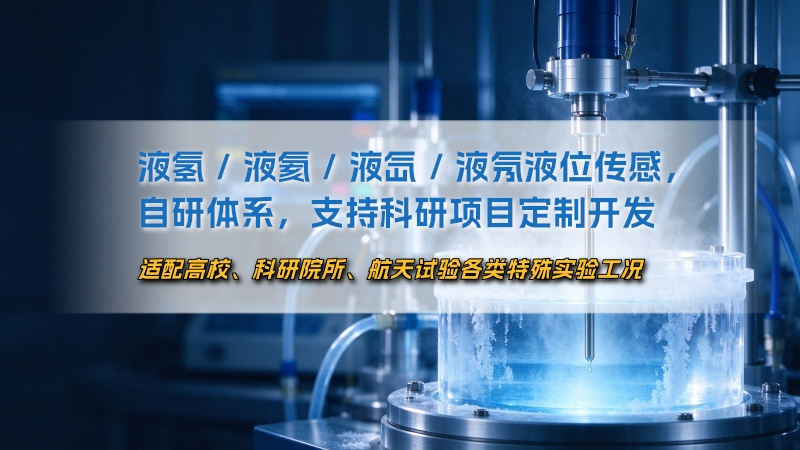
Relying on this self-developed system, the company has completed the development of a series of products including liquid hydrogen level meters, liquid helium level meters, liquid xenon level meters, and liquid neon level meters, suitable for scientific research laboratories and aerospace testing scenarios:
The liquid hydrogen level meter can operate stably at -253°C, and includes versions for tanks, vehicle-mounted cylinders, and lightweight drones, adaptable to various test carriers; the liquid helium level meter can withstand ultra-low temperatures of -269°C, with sensor structures verified under thermal shock, optimized sealing structures to reduce heat leakage, and measurement accuracy reaching ±1.5% FS; dedicated level monitoring solutions are also available for liquid xenon and liquid neon, meeting the continuous liquid level measurement requirements of rare cryogenic media.
There are significant differences between scientific research scenarios and industrial storage and transportation conditions. Laboratory conditions are variable, container specifications are scattered, and single experiments can be lengthy. If the instrument drifts or the seal fails, the entire experimental data may be invalidated. If you have special experimental conditions, you can submit detailed technical requirements, and the DeleeTech team will evaluate them specifically and provide a practical customized level measurement solution. Several of the company's instruments have already been deployed in domestic universities and research institutes' cryogenic experimental platforms, accumulating a wealth of real scientific experimental data. This is also a key difference compared to many manufacturers that only provide conventional standardized cryogenic instruments.
For research teams conducting experiments involving liquid hydrogen, liquid helium, liquid xenon, or liquid neon, when evaluating level measurement solutions, fundamental R&D capability, actual low-temperature measurement data, and customized support capabilities are core indicators that should not be overlooked. If you have research projects involving ultra-low temperature media level measurement needs, you are welcome to submit your project technical specifications to obtain a targeted, practical measurement solution. You can click [Contact Us] in the website navigation bar to start technical communication with the technical team regarding your project.